
Since its inception, ME Elecmetal has sought to enhance the circularity of its raw materials for the production of high-quality cast steel parts, responding to its production technology (electric arc furnace) and, above all, adding value to its customers.
Since the Company's founding in Chile in 1917, electric arc furnace (EAF) metallurgical casting technology has been implemented in its operations, being the first company in Latin America to incorporate it. This technology requires scrap as the main raw material for its operation; therefore, not only is the nature of the process circular, but when the cast part completes its life cycle and is disposed of as waste or byproduct on site, it is managed—in the case of ME South America and North America—by recovering and centralizing it in a special facility for processing, then re-entering the production cycle.
In ME China, something similar happens with some differences, given the regulations, geographical characteristics, and management adapted to these.
The planet, and by extension, the mining customer, are evolving from a linear mode of operation, where non-hazardous waste is disposed of in landfills, towards a circular approach, where waste is understood as byproducts and managed for reuse, extending their life cycle, as is the case with scrap.
This particularity is present in cast production and is the basis of the business model developed by ME Elecmetal due to the technology used, where globally, considering the three regions where its production plants are located, 95% of all raw materials used are recycled.
Part of the progress in raw material management within ME Elecmetal has been efficiently coordinating supply with production, which is monitored through two types of management indicators and by region, also consolidated.
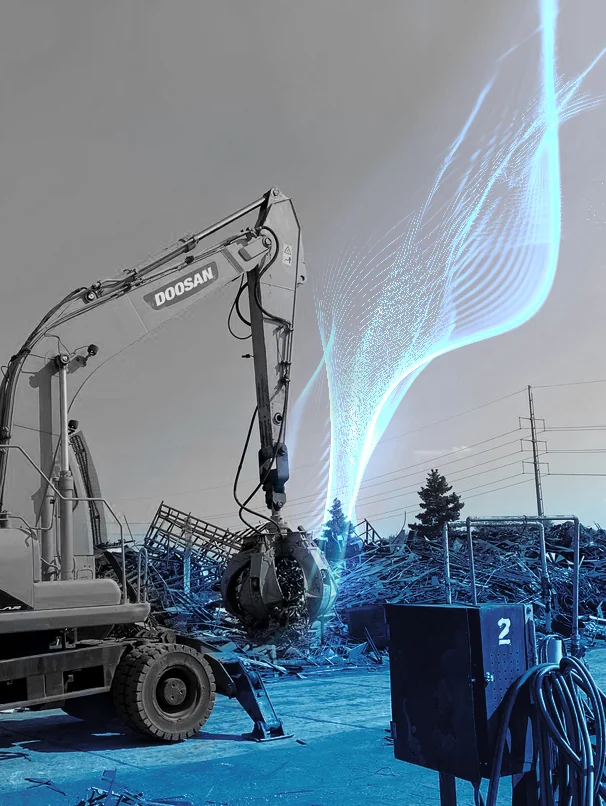
ME ELECMETAL SOUTH AMERICA
The Rancagua plant in Chile produced 27,380 tons of high-quality steels in 2023, using 96% recycled raw materials of the total inputs required.
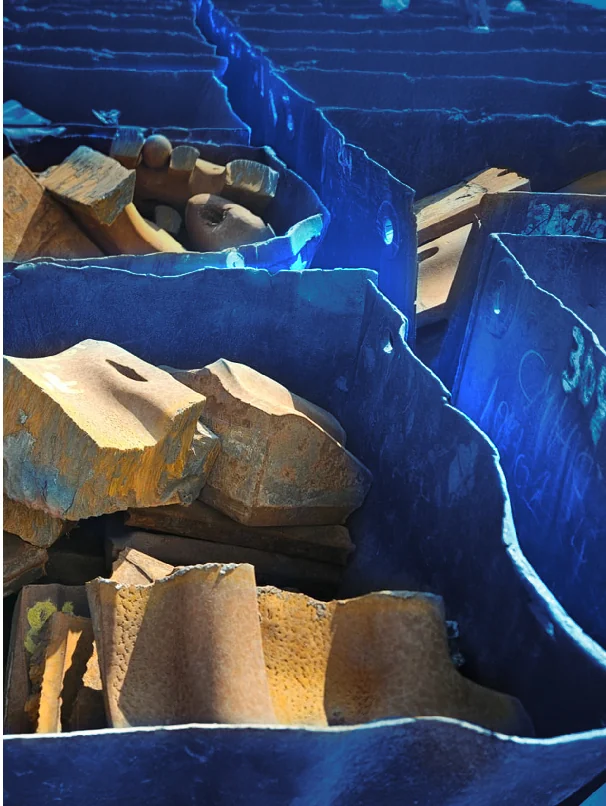
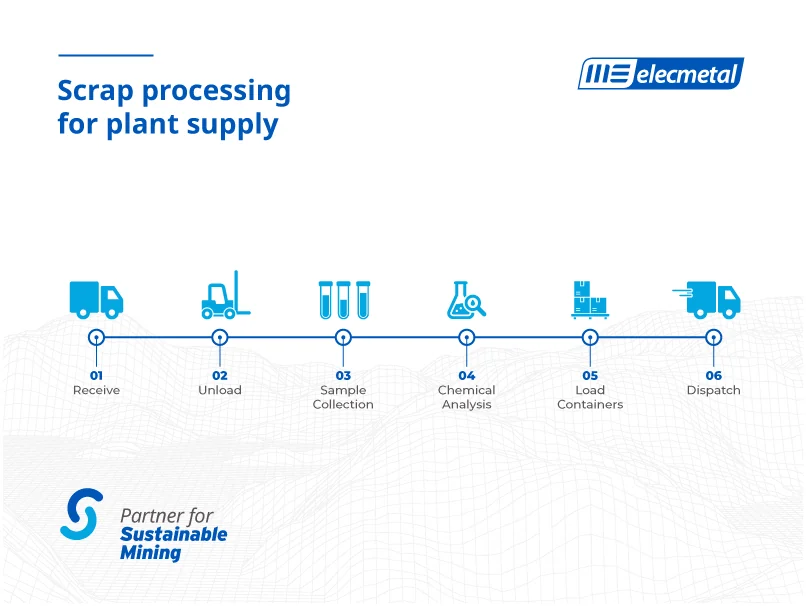
The recycling rate was made possible by coordinated and articulated work among the Commercial, Operations, Procurement, and Supply Chain areas, particularly at the Maipú Yard, a facility managed and led by women with a team of 55 professionals and operators, achieving together with procurement the recovery of 123% metallic raw material in 2023, thus supplying the Plant and reserving inventory for nearly half a year.
From the commercial business model perspective, in addition to supply agreements for cast parts sold to customers, in a significant number of cases a scrap recovery contract has been associated, recovering 91% scrap, achieving better services for customers and tracing the raw material back to the site and original supplier, where in 81% of cases it is produced by ME Elecmetal.
ME NORTH AMERICA
In the case of the plants in Tempe and Duluth, USA, in 2023 they produced 13,618 tons and 25,401 tons, respectively, using 95% and 93% recycled raw materials in each casting. Through procurement management, 78% of raw material has been recovered, tracing 61% to origin, corresponding to own parts recovered at the end of their mill life, plus purchases from third parties to reach total recovery via purchase.
ME CHINA
In the case of the Changzhou plant, in 2023 it produced a total of 27,356 tons, using 95% recycled raw materials. Through operations and procurement management, 56% of raw material has been recovered, tracing 3% to origin, corresponding to own parts captured at the end of their mill life. This is in the context of 95% of high-quality cast steel parts sales outside the national territory, and until recently, with import restrictions, therefore limiting effective recovery from customers.
Having visibility and control of the circular route of raw materials allows the metallurgical industry not only to ensure operational continuity levels and final production quality through efficiencies, but also enables the customer to better manage their disposal process, improving the logistics of this handling. Furthermore, it is critical because it reduces their downstream scope 3 carbon emissions and contributes to the same scope, thus closing a loop and improving services.

Ensure operational continuity and inventory of raw material -metallic byproduct-
for the production of high-quality steel liners, recovering from mining clients, meeting all technical, operational, and logistical requirements of each party, and maximizing the circularity of the main input.
Implement operational, logistical, and economic efficiencies in raw material recovery
ensuring the technical quality of the product with traceability to origin, reducing carbon emissions from transportation, and optimizing liner purchase costs for clients and raw material costs for the foundry.

Positively impact the logistical management of the mining client in their handling yards
supporting their reduction of carbon footprint in the supply chain under scope 3 and the recovery of potential environmental liabilities in their operation.
Significantly increase the lifecycle of the raw material
maximizing the circulation of the metallic raw material from the final production.
“The recycled metallic raw material we use in our manufacturing process has always been a key part of ME Elecmetal's Circular Economy and a very important aspect of our Integral Solutions offering to clients. We expect to continue growing our recycling capacity, tracing and formalizing this route from its origin. This way, we add efficiency throughout the chain, reduce our carbon footprint and that of our clients, and consolidate the quality of our final product.”
Metallic Raw Material:
Procurement:
| 2023 | CHILE | USA | CHINA | ME ELECMETAL |
| Total annual production (tons) | 27,380 | 39,019 | 27,356 | 93,755 |
| Annual total metallic raw material recovery percentage over total produced | 123% | 71% | 93% | 93% |
| Annual traceable recovery percentage to origin over total produced | 81% | 61% | 3% | 50% |
Production:
| 2023 | RANCAGUA | TEMPE | DULUTH | CHANGZHOU | ME ELECMETAL |
| Percentage of recycled raw material over total inputs | 95% | 95% | 93% | 95% | 94% |
Three indicators have been established for monitoring and managing metallic raw material:
- Tonnes of metallic raw material recovered per total annual production
- Percentage of metallic raw material recovered and traceable to origin
- Percentage of recycled material over total raw material in a year of production.
Source: Maipú Yard, 2024
Click to enlarge


